


 中文
中文 English
 Español
Waste in zipper film blowing rarely comes from a single source. It typically results from a combination of thickness variation, bubble instability, gel contamination, start-up losses, and edge trim. The most effective reduction strategy is to diagnose the dominant waste category first, then adjust the corresponding process parameters—rather than making broad changes across the line. This guide explains the common waste types, their root causes, and practical steps to reduce them on LDPE zipper film extrusion lines.
Blown film extrusion runs as a continuous process. A small irregularity—whether a temperature drift, a contaminated pellet, or an unstable bubble—can propagate across hundreds of meters of film before it is detected. By the time the defect reaches the winding station, the entire affected section may need to be scrapped.
Zipper film adds a further dimension: the film must not only meet thickness and optical requirements but also provide a consistent surface for zipper profile attachment. Any gauge variation or surface irregularity can compromise zipper sealing quality, leading to downstream bag rejects.
Reducing waste in this process therefore requires attention to both general blown film parameters and the specific requirements of zipper film production.
Based on production experience and published blown film troubleshooting data, waste in zipper film extrusion typically falls into five categories:
| Waste Type | Typical Manifestation | Primary Stage | Relative Impact |
|---|---|---|---|
| Thickness variation | Gauge bands across web width | Die and cooling zone | High—affects entire roll |
| Bubble instability | Oscillation, frost line fluctuation | Bubble formation zone | High—can cause line stoppage |
| Gel particles and specks | Fish-eyes, black specks | Extrusion and filtration | Medium—localized but recurring |
| Wrinkling and blocking | Winding defects, fold marks | Collapsing and winding | Medium—affects roll quality |
| Start-up and changeover scrap | Off-spec film during transitions | Line start-up | Variable—reducible with procedure |
Each category has distinct root causes and requires different corrective actions. Trying to address all five simultaneously usually leads to over-adjustment and further instability.
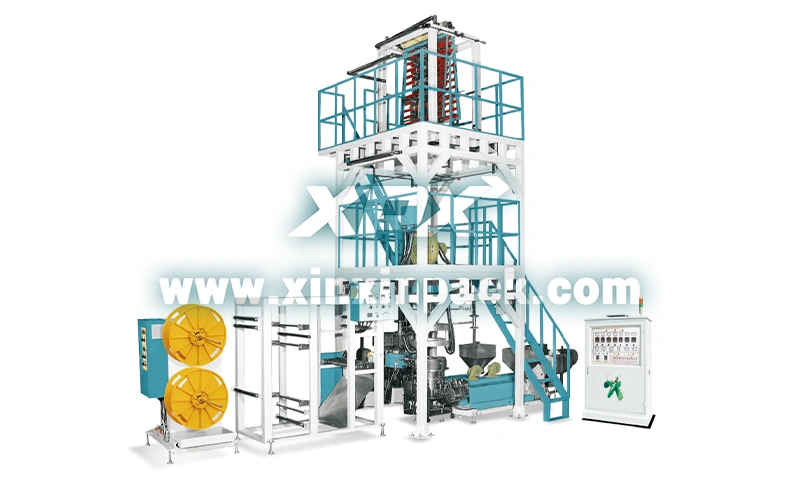
In blown film extrusion, thickness variation directly determines material utilization. When film thickness fluctuates, operators typically run heavier than the target specification to ensure that no section falls below the minimum requirement. This “running heavy” approach guarantees compliance but generates predictable and ongoing material waste.
Thickness variation can be classified into two types:
Machine direction (MD) variation: thickness changes along the length of the film. Often caused by extruder output drift, screw speed fluctuation, or haul-off speed inconsistency.
Transverse direction (TD) variation: thickness changes across the width of the film. Typically linked to die flow channel design, air ring uniformity, or temperature distribution around the die circumference.
Verify die gap consistency: Use a feeler gauge to check the die gap at multiple points around the circumference. A deviation exceeding ±5% of the nominal gap warrants adjustment or die inspection.
Check air ring airflow uniformity: Blocked or unevenly distributed air ring holes create localized cooling differences, which translate into thickness variation. Clean air ring passages on a scheduled basis.
Monitor melt pressure stability: Fluctuating melt pressure usually indicates inconsistent feeding, screen pack blockage, or temperature instability. A stable melt pressure profile is a prerequisite for consistent thickness.
Consider gravimetric or yield control: Automatic yield control systems continuously adjust extruder speed based on real-time material weight and line speed data. Published results suggest that tighter control can improve yield by approximately 2%–3% through reduced resin overuse.
Use online thickness measurement when available: Without real-time data, thickness adjustments are reactive and often late. Online gauging allows operators to detect deviation before a full roll is affected.
For lines where thickness consistency is critical to zipper attachment quality, reviewing the available configuration options on a dedicated zipper film blowing machine can help clarify what level of process control is practical for your production requirements.
Bubble instability—manifested as oscillation, frost line fluctuation, or irregular bubble diameter—is particularly damaging because it affects the entire film web simultaneously. A bubble that shifts left and right creates varying cooling conditions around the circumference, leading to gauge bands that can persist for the length of the instability event.
Common causes of bubble instability include:
Uneven air ring outlet distribution
Environmental air currents (open doors, HVAC vents, nearby equipment)
Die head temperature non-uniformity
Insufficient or inconsistent internal bubble cooling (IBC)
Inappropriate blow-up ratio (BUR) for the resin being processed
| Check | Method | Acceptable Condition |
|---|---|---|
| Air ring airflow | Anemometer reading at multiple points | Variation < 10% around circumference |
| Frost line height | Visual observation over 5-minute window | Fluctuation < 10 mm |
| Bubble diameter | Laser or ultrasonic measurement | Stable within ±2% of setpoint |
| Die temperature | Infrared or contact probe | Each zone within ±3°C of setpoint |
| Environmental airflow | Smoke test or visual assessment | No cross-flow affecting bubble |
If bubble instability persists after environmental factors are eliminated, the root cause is likely in the die, air ring, or resin formulation. In such cases, technical review of the extrusion system and cooling configuration may be required.
Gel particles and black specks are localized defects that—while small in area—can cause significant waste because they render affected sections of film unusable for zipper bag production. Common sources include:
Unmelted polymer from insufficient screw mixing
Carbon buildup in die flow dead zones
Screen pack degradation or breakthrough
Contaminated recycled material with incompatible polymer fractions
Additive or pigment agglomeration
Screen pack maintenance: Use a multi-stage filtration configuration. For operations processing recycled content, a continuous melt filtration system can maintain filtration efficiency without interrupting production for screen changes.
Purging routine: Establish a scheduled purging protocol using appropriate purging compounds to remove carbon buildup before it migrates into the film.
Die head inspection: Mirror-polished die heads with no dead zones reduce carbon accumulation. Inspect and clean die surfaces during planned maintenance windows.
Incoming material control: Verify recycled material quality and compatibility before blending. Incompatible polymer fractions are a frequent but often overlooked source of gel formation.
Wrinkling and blocking are often treated as downstream issues, but their root causes frequently originate in the film forming and cooling stages. Film that is wound too hot, with uneven thickness, or with insufficient slip properties will develop wrinkles or block on the roll. These defects may not be detected until the film reaches the bag-making stage, at which point the entire roll may be rejected.
| Problem | Likely Cause | Adjustment Direction |
|---|---|---|
| Longitudinal wrinkles | Uneven thickness; excessive tension | Check die and air ring; reduce winding tension |
| Diagonal wrinkles | Web misalignment; collapsing frame issue | Verify guide roller alignment |
| Blocking on roll | Insufficient cooling; inadequate slip agent | Increase cooling; verify slip additive level |
| Roll edge buildup | Edge trim not properly removed | Verify trim removal and edge guide function |
For zipper film specifically, wrinkles near the zipper attachment zone can prevent proper zipper sealing in the downstream bag-making process—turning a film issue into a full bag rejection.
Start-up and material changeover periods generate waste that is sometimes accepted as unavoidable. In reality, this waste is highly reducible through procedural discipline.
Pre-heat and stabilize: Ensure all temperature zones reach setpoint and stabilize before introducing material. Insufficient soaking time leads to off-spec film during the first minutes of production.
Prepare the next material in advance: For changeovers, pre-stage the incoming resin and purge material to minimize transition time.
Use a documented start-up sequence: A written procedure with specific checkpoints prevents variability between operators and shifts.
Track start-up scrap as a KPI: What gets measured gets managed. Recording start-up waste per changeover creates a baseline for improvement.
Use this checklist as a starting point for a structured waste reduction review:
Not every item will apply to every line. The purpose of this checklist is to provide a structured starting point for identifying the dominant waste source on your specific production setup.
Q1: What is the most common cause of waste in zipper film blowing?
Thickness variation is typically the most significant and persistent waste source, because it forces operators to run film heavier than necessary to guarantee specification compliance. This generates ongoing material overuse that accumulates across every production run.
Q2: Can recycled material be used in zipper film blowing without increasing waste?
Recycled material can be used, but it typically requires adjusted process parameters—including temperature profiles, screw speed, and filtration configuration—compared to virgin resin. The key is to verify recycled material quality and compatibility before blending, and to confirm that filtration is adequate to handle the contamination variability inherent in recycled feedstock.
Q3: How does bubble instability affect film waste?
An unstable bubble creates varying cooling conditions around the film circumference, which produces thickness bands and surface irregularities. These defects can persist for the entire length of the instability event, and the affected film is often unusable for zipper bag production.
Q4: What is the role of frost line height in waste reduction?
Frost line height influences both film properties and bubble stability. If the frost line is too low or unstable, the film may have inconsistent crystallinity and optical properties. If it is too high, the bubble may become difficult to control. Monitoring frost line height is a practical early indicator of bubble stability.
Q5: How can edge trim be handled to minimize waste?
Edge trim is an inherent part of the process. The practical approach is to recover it through an inline recycling system that returns trim material to the extruder feed. The recovery system should be sized to handle the trim output rate without causing feeding inconsistencies that could introduce new instability.
Q6: When should a production manager seek technical review for persistent waste issues?
If waste persists after thickness control, bubble stability, and contamination checks have been addressed, the root cause may involve die design, screw geometry, or cooling system configuration. In these situations, a technical review with the equipment supplier is the appropriate next step.
Reducing waste in zipper film blowing is a process of systematic diagnosis rather than universal adjustment. The most practical approach is to identify the dominant waste category on your line—thickness variation, bubble instability, gel contamination, winding defects, or start-up losses—and focus corrective actions on the relevant parameters.
The most important principle to remember: do not adjust multiple variables simultaneously. Each change should be isolated and its effect observed. This is the difference between effective waste reduction and a cycle of over-correction.
If waste persists after internal process adjustments, reviewing the mechanical configuration of the extrusion and cooling systems can clarify whether the limitation is procedural or equipment-related. The zipper film blowing machine category page provides an overview of available system configurations and process control options to support that evaluation.

Environmentally friendly materials
Integrated production lines
Maximising your return on investment