


 中文
中文 English
 Español
The speed of an LDPE zipper bag production line is not set by the bag making machine's nameplate rating alone. It is constrained by the interaction of four factors: LDPE material properties (melt strength, sealing window, cooling behavior), sealing system thermal dynamics (temperature–dwell time relationship), film cooling capacity, and the integration between upstream and downstream equipment. Most LDPE zipper bag lines achieve sustainable speeds between 120 and 220 bags per minute, but the actual figure depends heavily on film thickness, bag dimensions, zipper profile design, and how well the line's slowest link is managed.
This article examines each factor in sequence and provides a diagnostic framework you can apply to identify where your own line is losing speed—and what to do about it.
LDPE is widely used in zipper bag production because it offers good melt strength and a relatively wide heat-sealing window. These properties generally allow LDPE to run at higher speeds than LLDPE, which requires more heat input and often needs slower sealing cycles to achieve adequate bond strength. The specific formulation matters: melt index, density, additive package, and film thickness all influence how fast the material can be processed without compromising seal integrity or film stability.
However, LDPE's speed advantage has a ceiling. As line speed increases, sealing dwell time decreases. To maintain seal strength, sealing temperature must rise—but only up to the point where the film begins to degrade, burn through, or stick to the sealing bar. For 50-micron LDPE, the optimal sealing window is typically 120–160°C with a dwell of 0.2–0.5 seconds. If speed increases push temperature beyond 180°C, film degradation risk rises sharply. This creates a thermal ceiling that no amount of mechanical speed can overcome.
The relationship between speed and temperature follows a fundamental principle: seal strength is a function of the time–temperature integral. For a given film, there is an optimal temperature range. Exceeding it increases defect risk. The machine's control system must calculate the required temperature for the current speed, calibrated for each film type.
The practical implication is that the maximum sustainable speed of any LDPE zipper bag line is determined by the temperature limit of the film and the cooling capacity of the system. If the cooling system cannot bring the seal down to a safe handling temperature before the next cycle, speed cannot increase further. Water-cooled chill rollers with high heat transfer provide a higher thermal ceiling than air-cooled alternatives, which is why water-cooling configurations are often specified for higher-speed LDPE zipper bag production.
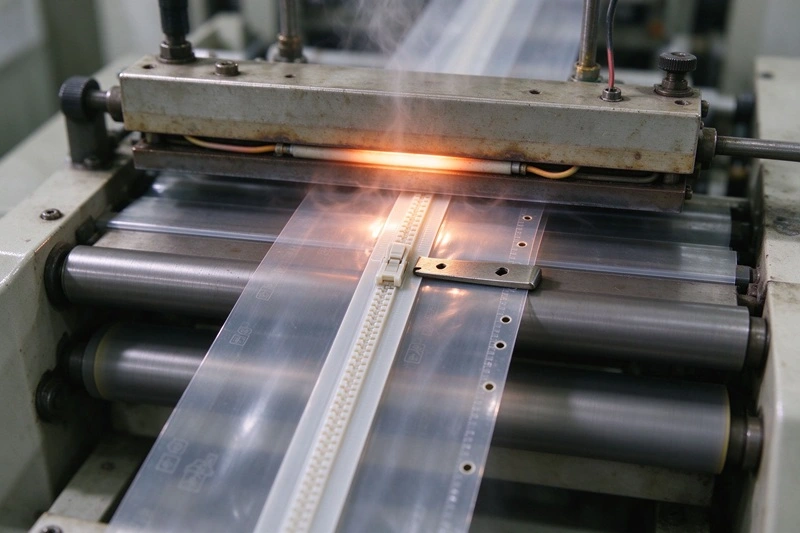
Cooling time is proportional to film thickness. Thicker films require longer cooling, which directly reduces achievable speed. This means that a line rated at 180 bags per minute for 40-micron LDPE may only sustain 120–140 bags per minute at 70-micron. Buyers evaluating equipment should always confirm the speed rating for their specific film thickness—not just for a reference specification.
The cooling system's effectiveness depends on chill roller surface temperature, contact time, and heat transfer efficiency. Water-cooled chill rollers generally outperform air-cooled systems in this regard. Modern lines may incorporate closed-loop cooling control that adjusts to film thickness and line speed automatically.
Zipper attachment introduces a second sealing operation that must be synchronized with the main bag seal. Inconsistent web tension causes the zipper profile to skew relative to the bag edge, leading to rejects, line stoppages, and rework. The zipper insertion area also acts as a heat sink, pulling energy away from the perimeter seal and creating uneven sealing unless the sealing system uses multi-zone temperature control—with separate zones for cross-seal, side-seal, and zipper-tack areas.
For LDPE specifically, zipper attachment requires precise temperature control because the zipper profile and the film may have different melting behaviors. The zipper material is often a different polymer grade than the bag film, and the bonding interface must be managed independently. Lines equipped with servo-driven sealing bars and fast-response temperature control can adjust sealing parameters in real time as line speed changes, maintaining bond quality without sacrificing throughput.
A zipper bag production line includes multiple stages: film blowing, printing, slitting, bag making, and optional packing and boxing. The overall output is constrained by the slowest link in this chain. If your bag maker runs at 200 bags per minute but the packing machine operates at 150, your effective line speed is 150.
Inline configurations—where blown film feeds directly into the bag maker without intermediate winding—eliminate handling steps and can improve overall efficiency. Tension control between machines is critical: inconsistent tension causes web breaks, registration errors, and unscheduled stops. Automatic roll changing reduces downtime between film rolls. Downstream equipment (bag sorting, boxing, bundling) must be matched to the bag maker's output to avoid accumulation and slowdown.
| Line Stage | Typical Constraint | Speed Impact | Diagnostic Check |
|---|---|---|---|
| Film Blowing | Output rate (kg/h), film width | Sets maximum film supply rate | Compare film output vs bag maker consumption |
| Printing | Web speed, drying capacity | Inline printing may limit line speed | Check if printing is the slowest stage |
| Bag Making | Sealing dwell, cooling time, bag length | Primary speed determinant | Verify rated speed for your film thickness |
| Zipper Attachment | Alignment precision, bonding time | Can reduce effective bag making speed | Monitor reject rate for zipper misalignment |
| Packing/Boxing | Throughput capacity | Must match bag maker output | Check for accumulation between stages |
When output is below expectation, work through this sequence:
Step 1: Measure actual output. Record good bags per shift, excluding setup and downtime. Divide by shift hours to get average BPM. Compare this to the machine's rated speed for your film specification. A well-run bag making plant typically achieves OEE above 85%.
Step 2: Identify the bottleneck stage. Observe where material accumulates or where operators intervene most frequently. Common bottlenecks include the sealing station (waiting for cooling), the zipper attachment area (alignment corrections), and downstream packing (capacity mismatch).
Step 3: Check sealing parameters. Verify that sealing temperature, dwell time, and pressure are within the optimal window for your specific LDPE film. Use an infrared thermometer to confirm actual sealing bar temperature. A PID-controlled system with ±2°C precision is preferable for high-speed operation.
Step 4: Evaluate cooling capacity. If sealing temperature is already at the upper limit for your film but speed cannot increase, the constraint may be cooling. Check chill roller surface temperature and contact time. Consider whether a water-cooled configuration would raise your thermal ceiling.
Step 5: Verify tension control. Inconsistent web tension causes zipper misalignment and film breaks. Closed-loop servo-driven unwinding systems with encoder feedback and load cells can maintain web strain within ±1% of setpoint, significantly reducing alignment rejects.
Step 6: Review changeover procedures. Frequent size changes reduce average output. Quick-change tooling and automatic parameter recall can reduce changeover time from hours to minutes.
Pre-Production Checklist for LDPE Zipper Bag Lines
Confirm film thickness and formulation match the machine's rated speed specification
Verify sealing temperature is within the optimal window for your LDPE grade
Check chill roller cooling capacity against film thickness and target speed
Test zipper attachment alignment at target speed before full production
Confirm downstream packing capacity matches bag maker output
Review changeover time and identify opportunities for quick-change tooling
Establish baseline OEE measurement for continuous improvement tracking
When evaluating a zipper bag production line for LDPE, the key specification to confirm is the speed rating for your specific film thickness, bag width, and zipper profile type. A machine rated at 180 pcs/min for a 500mm bag width and standard zipper may achieve different speeds with different configurations.
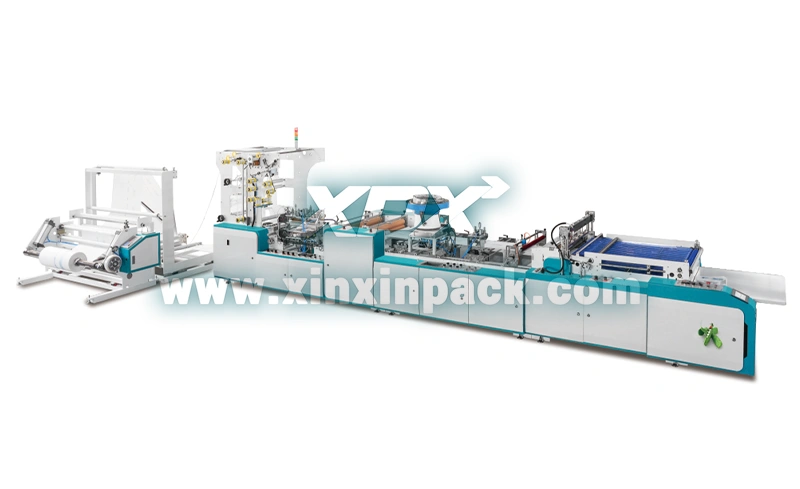
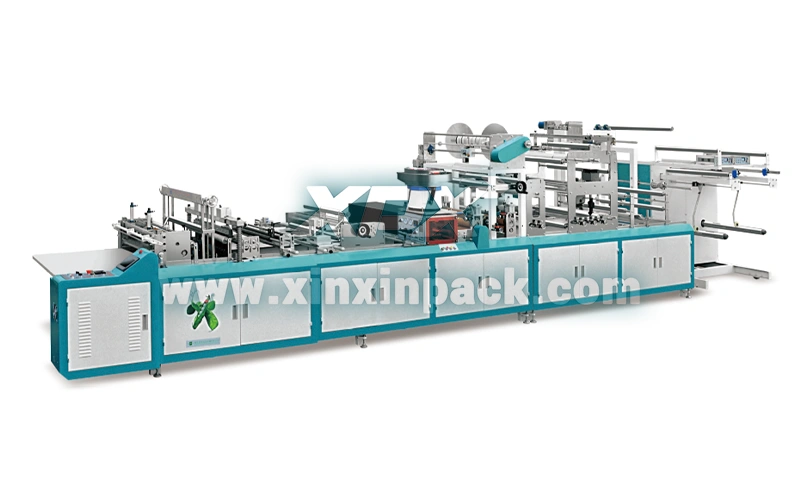
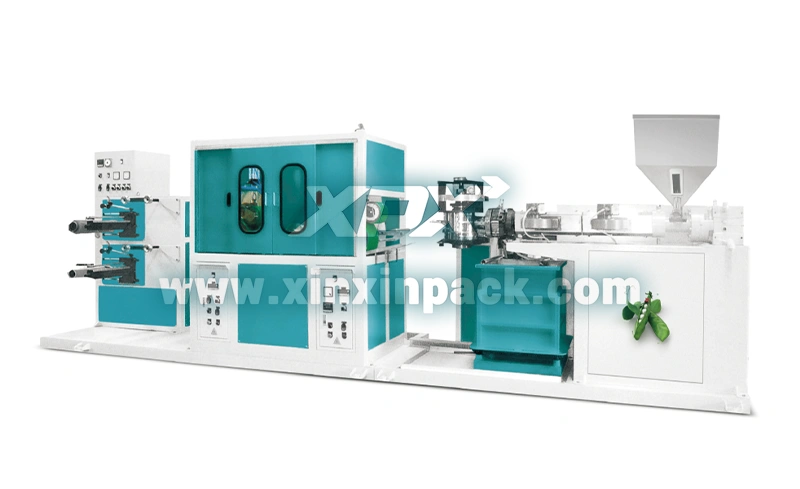
Review the available zipper bag making machine configurations to understand how different models and specifications affect your target output. For operations considering a fully integrated approach, the complete zipper bag production line combines blown film, printing, slitting, and bag making into a single synchronized workflow. If your production focuses specifically on LDPE, the high-speed LDPE zipper bag production line is configured for this material and includes inline printing and bag making. For a more detailed analysis of speed-limiting factors across different materials, the zipper film blowing machine page provides information on how film production parameters affect downstream bag making speed.
Q: What is the maximum speed for an LDPE zipper bag production line?
A: Sustainable speeds typically range from 120 to 220 bags per minute, depending on film thickness, bag dimensions, zipper profile, and line configuration. Thicker films (70-micron and above) generally run slower than thinner films (40-micron) due to longer cooling requirements. The maximum speed is ultimately constrained by the sealing temperature limit of the film and the cooling capacity of the line.
Q: Why does my LDPE zipper bag line slow down when I increase the sealing temperature?
A: Increasing sealing temperature beyond the film's optimal window (typically 120–160°C for 50-micron LDPE) can cause film degradation, burn-through, or sticking. When this happens, operators must slow the line to prevent defects. The correct approach is to optimize cooling capacity and tension control rather than pushing temperature higher.
Q: How does film thickness affect LDPE zipper bag production speed?
A: Cooling time is proportional to film thickness. A 70-micron film requires significantly longer cooling than a 40-micron film, which directly reduces achievable cycle speed. Always confirm the machine's speed rating for your specific film thickness before purchase.
Q: Can I run LLDPE on a line configured for LDPE?
A: LLDPE can often be processed on LDPE-configured lines, but it typically requires higher sealing temperatures and may need slower sealing cycles. Speed ratings may be lower. Material compatibility should be confirmed with the equipment supplier based on your specific formulation.
Q: What is the most common cause of LDPE zipper bag line speed loss?
A: Inconsistent web tension is one of the most frequent causes. It leads to zipper misalignment, film breaks, and unscheduled stops. A closed-loop tension control system with servo-driven unwinding can maintain stable tension even during splice cycles, significantly reducing speed loss from alignment corrections.
The speed of an LDPE zipper bag production line is ultimately determined by the interaction between material properties, sealing thermal dynamics, cooling capacity, and line integration. LDPE's good melt strength and wide sealing window give it a natural speed advantage, but the thermal ceiling of the sealing process and the cooling time required for thicker films set hard limits on achievable throughput.
The most important step you can take is to measure actual output against the machine's rated speed for your specific film specification. If there is a gap, work through the diagnostic sequence: sealing parameters, cooling capacity, tension control, and integration between stages. When the gap cannot be closed with process optimization alone, equipment configuration may be the limiting factor.
Review the available zipper bag making machine configurations or contact our engineering team to discuss your specific film, bag dimensions, and target output requirements.

Environmentally friendly materials
Integrated production lines
Maximising your return on investment