


 中文
中文 English
 Español
Moving from a semi-auto zipper bag operation to a fully automatic line changes more than machine speed. It reshapes operator roles, floor layout, quality control methods, maintenance routines, and the way capital is allocated. The most important shift is not a single parameter but the integration of previously separate steps—film blowing, printing, bag making, and packing—into one continuous workflow. This article explains what actually changes and how buyers should evaluate each dimension before upgrading.
A semi-automatic zipper bag operation typically uses standalone machines. Film may be purchased from an external supplier or produced on a separate blown film unit. Printing is done on a separate press. Bag making happens on a dedicated zipper bag making machine. Finished bags are collected manually or with a simple stacking device. Each step has its own operator, its own quality check, and its own downtime pattern.
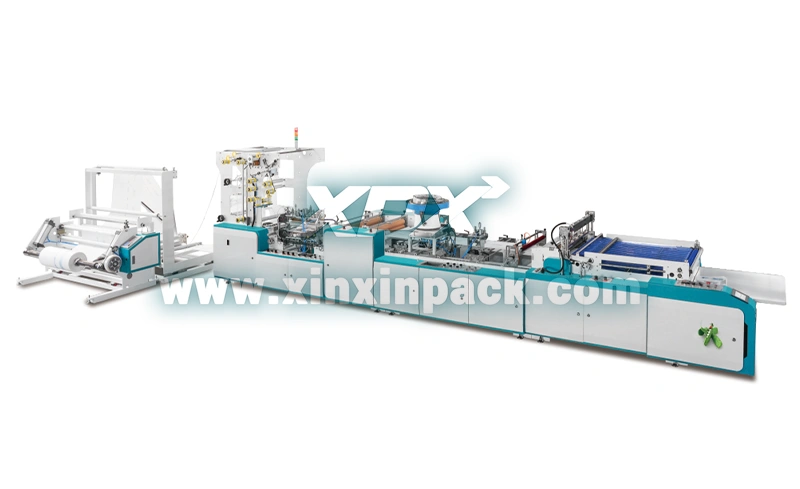
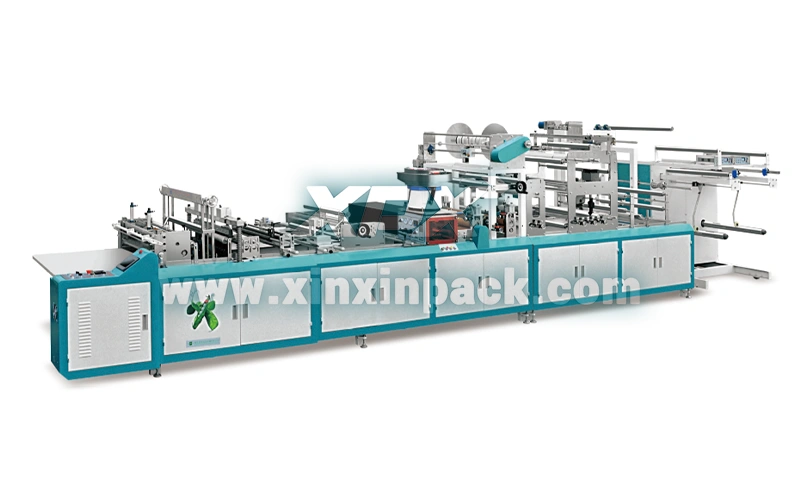
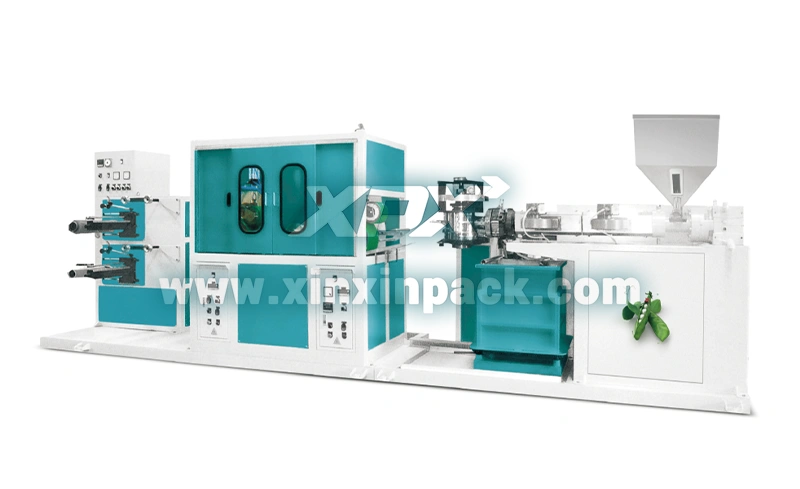
A fully automatic zipper bag production line connects these steps into a single flow. The line starts with raw material feeding and ends with finished bags packed into cartons. Film blowing, printing, slitting, bag making, bundling, bagging, and boxing are linked by a synchronized control system. This integration is the source of nearly every other change discussed below—it is also the reason why upgrading is a production-system decision, not just a machine purchase.
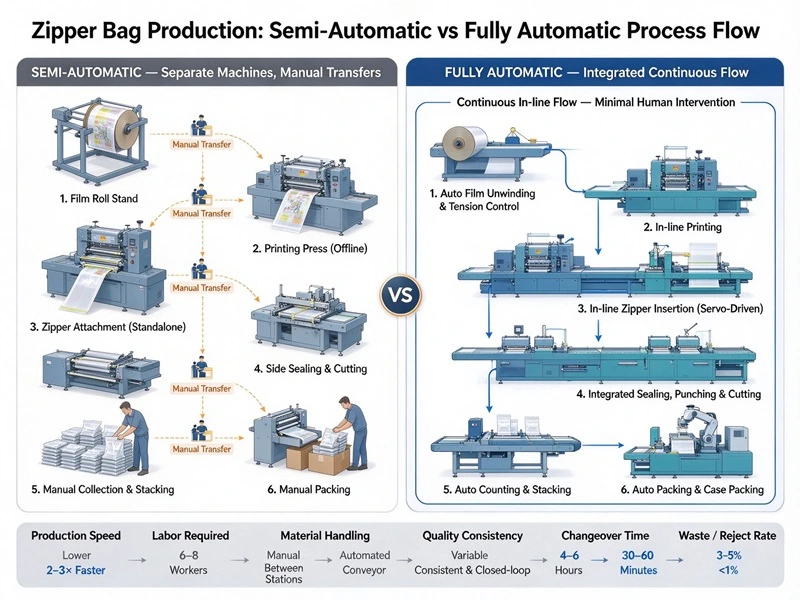
In a semi-automatic setup, operators are directly involved in the production process. They load film rolls, adjust sealing parameters, remove finished bags, and inspect output at multiple stages. Industry guides suggest that semi-automatic zipper bag machines may need two to three workers for manual feeding and stacking, depending on the configuration. Each machine in the sequence may require its own operator or share one operator across several units, creating coordination challenges.
On a fully automatic line, the operator role shifts from production to supervision. The line requires one to two operators for monitoring, material loading, and quality checks. The system handles feeding, sealing, cutting, and packing automatically. This change has several practical implications:
Labor cost structure: Fewer operators are needed per shift. For factories running multiple shifts, the reduction in headcount compounds.
Skill requirements: Semi-auto operation rewards hands-on dexterity and experience with individual machines. Automatic line operation rewards system-level understanding—reading PLC data, interpreting alarm codes, and coordinating material supply across the line.
Training focus: New operators need training on safety systems, emergency stops, and the overall workflow rather than individual machine mechanics. Xinxin provides installation, debugging, and comprehensive training as part of its service scope.
The trade-off is that automatic lines require PLC programming knowledge and manufacturer-trained engineers for advanced troubleshooting, while semi-automatic machines are mechanically simpler and most technicians can troubleshoot them locally. Buyers should assess whether their existing maintenance team can support the new system or whether they need to plan for external technical support.
Published speed figures can be misleading if not placed in context. A semi-automatic zipper bag machine may be rated at 100–120 pieces per minute in isolation, but the actual throughput is often lower because of manual transfer between steps, operator-paced loading, and quality checks that interrupt the flow.
A fully automatic line integrates these steps and can sustain higher effective output. For reference, the High Speed LDPE Zipper Bag Production Line (ZIP-500L) is rated at 30–180 pcs/min depending on configuration, integrating film blowing, printing, and bag making. The Automatic Zipper Bag Production Line (ZIP-500L) is rated at 50–220 pcs/min, integrating bag making, bagging, and carton packing. These figures represent machine-rated speed, not guaranteed output—actual performance depends on material, bag design, and operating conditions.
The more important comparison is not the peak speed number but the sustained output per shift. An automatic line maintains consistent pacing because the control system synchronizes each stage. A semi-auto setup may run faster on a single machine but loses time at every transfer point. Buyers evaluating an upgrade should calculate output per shift including changeover time, material loading stops, and quality interruptions, not just the rated speed of the fastest machine in the sequence.
A semi-automatic operation often grows organically. Machines are added as demand increases, with material stored between stages, finished goods staged in open areas, and operators moving between workstations. This layout can work at small scale but becomes a bottleneck as volume grows.
An automatic zipper bag production line is designed as an integrated system from the start. The line configuration links film blowing, printing, slitting, and bag making in a continuous sequence. For example, the High Speed LDPE Zipper Bag Production Line has a footprint of 1300×2500×5000 mm for the ZIP-500L model. The Automatic Zipper Bag Production Line, which adds packing and carton stacking, has a footprint of 15000×2500×5000 mm. These dimensions illustrate that an automatic line requires a dedicated, planned floor area rather than an incremental addition to an existing workshop.
Buyers upgrading from semi-auto should evaluate:
Available floor space and ceiling height for the integrated line
Power supply capacity (the automatic line typically requires AC380V 50Hz and higher connected load)
Material flow from raw material storage to finished goods warehouse
Space for maintenance access and spare parts storage
In semi-automatic production, quality depends heavily on operator attention. Seal temperature must be checked and adjusted manually. Zipper alignment is verified visually. Finished bag dimensions are measured periodically. Variability between operators and between shifts can introduce inconsistencies that only surface at the customer's end.
An automatic line embeds quality control into the process. Servo-driven film transport maintains consistent tension, reducing the risk of wrinkles and misalignment. Sealing parameters are controlled by the system rather than adjusted by hand. The ZIP-500L automatic line is rated for sealing and cutting tolerance within ±0.5 mm, with a reported qualification rate above 99% for wrinkle-free output under specified operating conditions. These figures represent performance under validated conditions and should be confirmed for specific material and bag designs.
The practical change for buyers is that quality management shifts from “inspect and correct” to “monitor and maintain.” The automatic line still requires quality checks, but the checks confirm that the system is running within parameters rather than catching individual defective bags.
Semi-automatic machines are mechanically simpler. Common issues—film tension drift, sealing temperature variation, zipper misalignment—can often be diagnosed and corrected by an experienced operator or local technician. Spare parts are generally accessible and replacement procedures are straightforward.
Automatic lines introduce additional systems: servo drives, PLC controllers, synchronized motion control, and automated packing mechanisms. These systems offer greater consistency but require different maintenance capabilities. Common maintenance tasks still apply—cleaning the film path and seal zones, checking belt tension, lubricating according to the manufacturer's map—but troubleshooting often requires understanding the control system, not just the mechanical components.
Buyers should plan for:
Operator training: Xinxin provides training on the specific line configuration, but factories should budget for ongoing skill development as the team gains experience with the automatic system.
Spare parts strategy: Automatic lines use more servo motors, sensors, and control components. A spare parts plan should cover the components most likely to require replacement.
Technical support access: The ability to reach the manufacturer's engineering team quickly matters more on an automatic line than on a semi-auto machine. Xinxin's service network is structured to provide technical response, and buyers should confirm support terms for their region.
The capital cost of an automatic line is higher than a semi-automatic setup. But the investment decision should not be based on purchase price alone. Buyers should build a cost model that includes:
| Cost Factor | Semi-Auto | Automatic Line |
|---|---|---|
| Initial equipment investment | Lower per unit; can be phased | Higher; integrated system purchase |
| Labor per shift | Higher headcount, more manual tasks | Lower headcount, supervisory roles |
| Floor space | Flexible, can grow incrementally | Requires planned dedicated area |
| Material waste | Higher variability, more startup waste | More consistent, less startup waste |
| Maintenance skill | Local technician capable | Requires trained technician or manufacturer support |
| Output consistency | Operator-dependent | System-controlled within parameters |
| Scalability | Limited by manual bottleneck | Can support higher sustained output |
The payback period depends on factors specific to each factory: local labor costs, current utilization rate, product mix, and the price premium the market pays for consistent quality. Buyers should model these factors with their own numbers rather than relying on generic ROI claims. A factory running one shift at low volume may find that a semi-auto setup remains more cost-effective, while a factory running multiple shifts with growing order volume may reach the break-even point faster than expected.
Semi-auto remains a practical choice when:
Daily output is below the threshold where manual transfer becomes the bottleneck
Product mix changes frequently and changeover time is a priority
Capital is limited and the factory prefers to reinvest gradually
Local technical support for advanced control systems is not readily available
The factory produces short runs of many different bag specifications
An automatic line becomes worth evaluating when:
Order volume is stable and growing, and manual transfer limits daily output
Labor cost is a significant and rising share of production cost
Quality consistency is a customer requirement, not just an internal goal
The factory has or can develop the technical capability to support an integrated system
Floor space and utilities can accommodate a dedicated production line
Before deciding to upgrade, work through these items with your production and finance teams:
Q: Can a semi-automatic zipper bag machine be upgraded to automatic later?
A: Generally no, not as a simple add-on. The automatic line integrates film blowing, printing, and bag making with synchronized controls. A semi-auto machine operates as a standalone unit. Upgrading typically means purchasing a new integrated line rather than modifying the existing machine. Some buyers run both in parallel during a transition period to maintain output while commissioning the new line.
Q: How many operators does an automatic zipper bag line require?
A: Published guides suggest one to two operators for monitoring, material loading, and quality checks on a fully automatic line. Actual requirements depend on line configuration, level of automation in packing, and factory-specific quality procedures. Buyers should confirm operator requirements with the supplier based on their specific line specification.
Q: Does an automatic line eliminate the need for skilled operators?
A: No. The skill profile changes. Semi-auto operation rewards hands-on machine adjustment experience. Automatic line operation rewards system-level understanding—reading PLC data, interpreting alarms, and coordinating material flow. Factories still need trained personnel, but the training focuses on different competencies.
Q: What is the typical footprint difference between semi-auto and automatic?
A: A semi-auto setup can be arranged in a more flexible, modular way, with machines placed according to available space. An automatic line requires a planned linear or L-shaped layout. As a reference, the ZIP-500L automatic line with packing has a footprint of 15000×2500×5000 mm. Buyers should request a layout drawing based on their specific bag size and material.
Q: How does material waste compare between semi-auto and automatic lines?
A: Automatic lines generally produce less startup waste because the control system synchronizes film feeding, tension, and sealing parameters from the beginning of a run. Semi-auto setups may require more manual adjustment at startup, generating more waste during changeovers and after stoppages. Actual waste levels depend on material, bag design, and operator experience.
Q: Should I buy an automatic line if I only run one shift per day?
A: It depends on your output target and labor cost. A single-shift operation with moderate output may find a semi-auto setup sufficient. If one shift on an automatic line can replace the output of two shifts on semi-auto while using fewer operators, the labor savings may justify the investment. Run the numbers with your own data before deciding.
The move from semi-auto to automatic on a zipper bag line is a change in how production is organized, not just how fast a machine runs. The most important factors to evaluate are operator role changes, sustained output per shift, floor layout requirements, quality control approach, maintenance capability, and total cost structure. Buyers should not compare rated speeds in isolation or assume that automation automatically reduces cost—the payback depends on utilization, labor rates, and product consistency requirements specific to each factory.
If your evaluation suggests that an integrated line fits your production profile, review the available production line configurations to understand how film blowing, printing, bag making, and packing are connected. For factories with existing film supply or composite bag requirements, the semi-automatic composite line offers a different path that avoids film blowing investment while still improving consistency. Discuss your material specifications and output targets with the engineering team before finalizing a configuration—material testing on your actual film and zipper profile is the most reliable way to confirm line performance.

Environmentally friendly materials
Integrated production lines
Maximising your return on investment