


 中文
中文 English
 Español
A mid-size specialty coffee brand was ready to launch a cold brew in a matte-finish stand-up pouch. Their design called for a deep black background, vibrant fruit accents, and a high-resolution texture pattern. When quotes landed, the team froze: gravure promised the pop they wanted, but the unit cost at their 15,000-unit run would devour margins. Flexo was affordable, yet the early proof looked muddy on the prototype film. Digital looked sharp on one sample but showed banding on the next. The question they kept returning to was simple: “Which process actually delivers the quality we need, at a cost that makes sense for this film job?”
That tension is familiar to anyone sourcing film packaging today — snack pouches, frozen fruit bags, retort-ready laminates, or shrink sleeves. There is no single “best” process, but there is a best-fit process for your specific mix of run length, graphic complexity, and film type. Understanding the levers that tip the balance can prevent you from overspending on over-engineered prints or, worse, settling for a result that hurts shelf appeal.
Film substrates magnify every printing variable. Unlike paper, films like PET, BOPP, and PE don’t absorb ink — they hold it on the surface. That makes dot gain, solvent evaporation, and static control much bigger cost-quality knobs. A process that prints beautifully on a rigid paperboard can disappoint on a high-slip film if the ink doesn’t wet out correctly or the film stretches under tension.
Three processes dominate today’s film packaging landscape, each with a distinct cost-quality fingerprint. Evaluating them fairly means looking past glossy brochures and at what happens on a live web.
• Flexography (flexo): Uses photopolymer plates mounted on a cylinder, with an anilox roll metering ink to the plate. Modern flexo on film has progressed far beyond simple line work. High-definition plates, 1,800+ LPI anilox engravings, and servo-driven decks can now deliver smooth vignettes and fine text that once required gravure. Ink sets for film — solvent-based, water-based, or UV — are well established. Unit costs drop rapidly after setup, making flexo attractive for medium runs. However, plate costs and setup time still demand a minimum run length, typically 5,000–10,000 impressions, to feel comfortable.
• Gravure: A metal cylinder is engraved with millions of tiny cells that transfer ink directly to the film. The result is a continuous-tone-like richness that few other analog processes match, especially on extended-gamut designs. For very long runs — think millions of pouches for a global snack brand — the per-unit cost becomes the lowest of all. The catch is the cylinder itself: a single gravure cylinder can cost thousands of dollars and take weeks to produce, making short and even medium runs prohibitive. The film must also tolerate the solvent-based inks and dryer heat typical of gravure presses.
• Digital: Either inkjet or electrophotographic (liquid toner) presses that eliminate plates and cylinders entirely. The digital proposition is strongest for short runs, variable data, multiple SKU versions, and rapid prototyping on the actual production substrate. Quality on film has improved dramatically: 1,200 dpi output with white ink underlays now makes digital a realistic choice for small-batch specialty pouches and regional promotions. The trade-off is speed and per-unit cost — digital clicks don’t benefit from the same economies of scale, so costs stay relatively flat regardless of volume. There can also be film compatibility constraints, especially on heat-sensitive substrates, unless the press is designed with low-temperature curing.
The interaction between process and film becomes clearer when you look at actual data. According to a 2023 Smithers report The Future of Flexible Packaging Printing to 2026, converters report that substrate-related waste — mainly from tension issues and solvent retention — accounts for 12–18% of total job cost on standard films, a figure that drops sharply when the press architecture itself is designed around film handling. This is where looking at film-specific, modular web-fed systems can change the economics before a single job even starts. Explore modular web-fed systems that are engineered for extensible films.
Ask a typical converter and you’ll hear a rule of thumb: below 5,000 linear meters, go digital; above 50,000, go gravure; flexo owns the middle. Like most rules of thumb, it oversimplifies. Several film-specific factors nudge the sweet spot left or right:
Color count and ink coverage – A 7-color extended-gamut flexo job costs more in plates and wash-up than a 3-color line-art job. If the design needs many spot colors, digital’s fixed cost structure becomes more attractive. Conversely, heavy solid ink coverage on digital can become expensive quickly because of ink consumption.
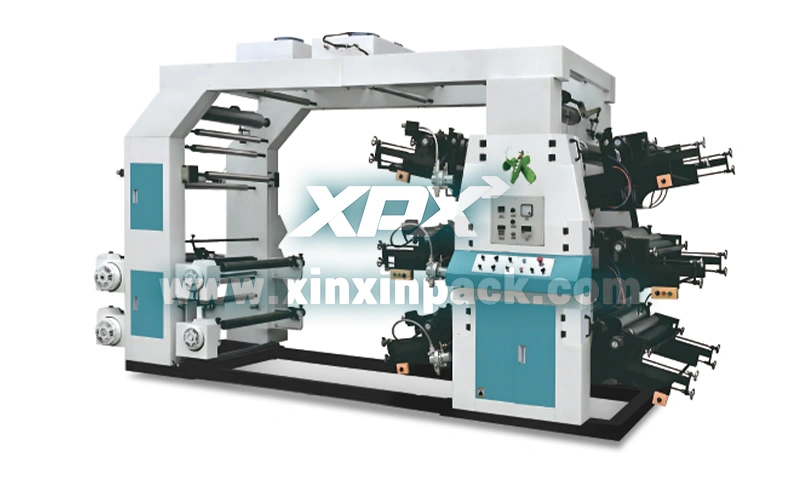
Substrate stretch and gauge – Thin, extensible films (think 12 µm PET or low-gauge PE) punish any process that lacks tight tension control. A well-configured flexographic printing machine with a central impression (CI) drum and servo-driven infeed/outfeed can hold register to ±0.05 mm on these films, a precision that closes the quality gap with gravure on all but the most demanding skin-tone work.
Post-print processing – If the pouch must withstand retort sterilization or aggressive filling lines, ink adhesion and bond strength become non-negotiable quality metrics. Some digital inks are still gaining certification for retort applications, while flexo and gravure have decades of proven performance. That can override pure cost calculations.
When converters map their real-world jobs, many find that the cost-quality equilibrium is not a single process but a hybrid mindset: using the right engine for the right part of the job. Digital printing machines for flexible packaging have evolved from prototyping curiosities into production engines that can handle inline priming and white on film at speeds above 80 m/min. Meanwhile, central impression drum platforms now allow flexo to print photographic-quality art on shrink sleeves and flow wraps that used to go straight to gravure.
Making the choice concrete: a side-by-side lens
| Dimension | Flexo (CI) | Gravure | Digital (Inkjet/Toner) |
|---|---|---|---|
| Ideal run length | 10,000 – 200,000 linear m | >100,000 linear m | <10,000 linear m, multi-SKU |
| Cost structure | Medium plate & setup, low ink cost, sharp decline with volume | High cylinder cost, lowest ink cost, very flat at high volume | No plate cost, high click charge, flat cost curve |
| Quality ceiling on film | 175–200 LPI with HD plates, excellent text & solids | 250+ LPI equivalent, unbeatable smoothness | 1,200 dpi, strong for short-run photo, can show banding on large solids |
| Film compatibility | Broad; works with treated PET, BOPP, PE, PA, shrinks | Broad; excellent for thin films, but high dryer temperature can deform certain substrates | Improving; check for primer needs, heat sensitivity, and retort compliance |
| Setup time & waste | 15–30 min changeover, 200–300 m waste typical | 45–90 min cylinder change, 500–800 m waste | Near-zero setup, <50 m waste |
| Variable data / versioning | Limited, requires plate changes | Not practical | Inherent; every impression can differ |
The table reveals something important: quality is not an absolute number. A crisp 175 LPI flexo job with a matte overprint varnish on BOPP can outshine a muddled gravure job on an ill-prepared substrate. Quality means fitness for the brand’s purpose, on its specific film, under its filling-line conditions. Once that definition is sharp, cost becomes a filter rather than a compromise.
Rather than chasing an abstract “best” process, successful packaging buyers evaluate three gateway questions:
What is the visual task? If the pack’s role is to telegraph “premium” through a photorealistic raspberry on a matte black field, and run lengths will exceed 200,000, gravure remains the benchmark. If the job is a vibrant, block-color frozen vegetable bag with moderate detail, flexo will exceed expectations at a fraction of the cylinder cost.
How flexible is the supply chain? The pandemic-era shift toward smaller, more frequent orders hasn’t reversed. Brands now demand 12 SKU flavors with identical base graphics. This multi-SKU reality shifts the balance toward digital or a flexo-digital hybrid line that prints the static art in flexo and overlays variable elements digitally. Flexible hybrid solutions that combine analog and digital on the same web are becoming a real option for mid-tier converters who want to avoid turning away short-run requests.
What is the true cost of “good enough”? A 2019 FTA (Flexographic Technical Association) study compared consumer perception of the same coffee bag printed on film via flexo and gravure at a standard viewing distance of 60 cm. For non-photographic designs, consumer preference was statistically identical, even though the flexo print showed measurable differences in dot structure under a loupe. That insight can save tens of thousands of dollars in cylinder costs across a brand’s SKU portfolio without hurting sales.
The ISO 12647-6 standard for flexographic printing provides objective metrics — dot gain, solid ink density, and color difference tolerances — that help align buyer expectations with process capability. When a press meets these tolerances consistently, it’s delivering commercial quality, even if a densitometer tells a different story than a gravure proof. Seasoned operators know that on film, stability matters more than a single perfect pull-down. They’ll monitor the web tension, dryer temperature, and corona treatment level relentlessly because a deviation of 0.5 N in tension can introduce misregister that no amount of prepress magic can fix.
No matter which process emerges as the strategic fit, the execution sits on the shoulders of the press. Film handling — the ability to run thin, extensible substrates without wrinkles, static marks, or tension-induced distortion — is not an add-on; it’s the foundation. A press with an undersized dryer or a flimsy unwind will waste the quality potential of the best prepress team and the finest ink set.
This is where brands and converters often find themselves stuck in a false choice between “affordable” and “film-capable.” The market has moved on: servo-driven, modular platforms now allow shops to start with a configuration that matches today’s job mix and extend capabilities later — adding a deck, upgrading the drying, or integrating inline inspection — without scrapping the entire investment. When evaluating such platforms, look for features like chilled impression drums for heat-sensitive films, automatic viscosity control for solvent inks, and web cleaning systems that prevent the “fish eye” defects that plague high-slip films.
If you’re trying to pin down a configuration that fits the films you actually run — not a generic spec sheet — it helps to work with a manufacturer that has deep film expertise built into the platform from day one. Xinxin’s range of film packaging solutions combines web handling technology refined across thousands of film jobs with the flexibility to switch between water-based and solvent inksets without major retrofits. For converters handling tricky laminated films or high-speed single-layer PE, having access to an application-focused engineering team can cut months of trial-and-error out of the ramp-up phase.
Ultimately, the right printing machine for your film project should be justified by a total cost of ownership lens, not just the upfront purchase price. Calculate the cost over 5 years, including plates or cylinders (or their absence), ink waste, setup time, and the very real expense of rejected reels when film temperature control fails. That calculation often reveals that the process which looks expensive on the price list becomes the most economical across a portfolio of jobs.
The coffee brand at the start of this article landed on flexo with HD plates and an extended gamut ink set, supported by a CI press that held tension on their chosen matte PET laminate. The result: a pouch that, on shelf, was indistinguishable from the gravure reference in a 20-person consumer panel, at a unit cost 23% lower than the gravure quote. Their digital option still serves seasonal limited editions, but flexo became the backbone.
Your cost-quality equilibrium will sit at a different intersection. The key is to stop asking “which process is best” and start mapping your own job mix, film types, and shelf-impact goals onto the real capabilities of today’s film-oriented presses. Run the numbers, request pull-downs on your actual substrate, and watch how the web behaves at full speed — because what looks balanced in a quotation can go out of register on the production floor.
Disclaimer: This article provides general information for educational purposes. Actual process and equipment selection should be based on specific material testing, production conditions, and technical consultation.

Environmentally friendly materials
Integrated production lines
Maximising your return on investment